10×10 Room Painting Cost in India: How Much Paint and Labour Will You Need?
Work out the paint quantity and painting cost for a 10×10 ft room, from measuring the walls to choosing packs and comparing a painter's quote.
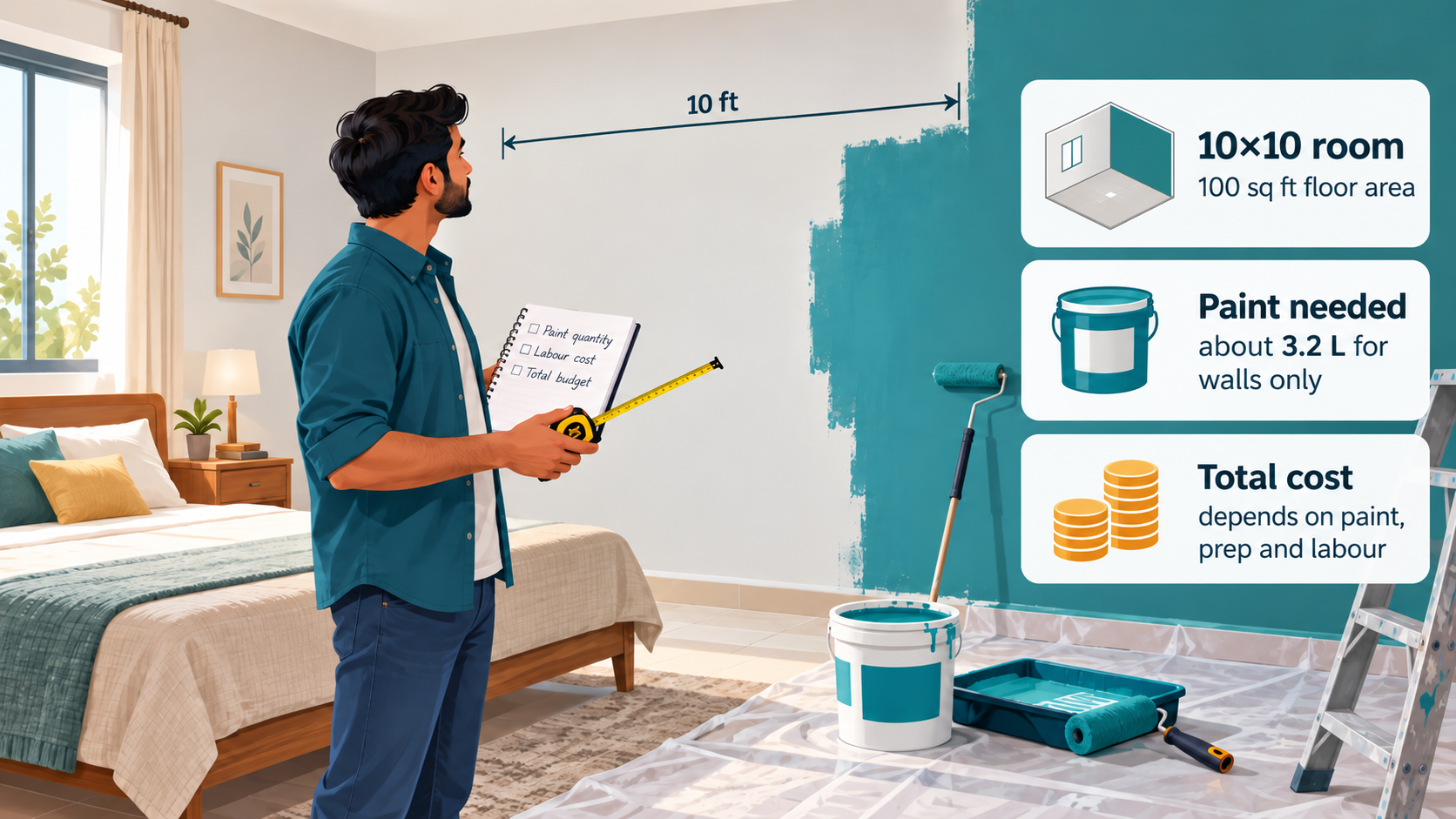
painting
In this guide6 sections
The room has looked the same for years. One evening, with a paint shade card held against the wall, you decide it is time for a change. It is only a 10×10 ft bedroom, after all. How much paint could it need?
Then the questions arrive. The ceiling too? What about the damp patch beside the window? Does the painter's price include putty? A small room can produce a surprisingly long conversation. For a 10×10 ft room with 10 ft high walls, one door and one window, the example here needs about 3.23 litres of finish paint for the walls. A 4 L pack could cover that requirement, if your chosen paint is sold in that size. The ceiling, primer and putty have their own part in the story.
To put a bill beside that quantity, we will use a ₹953 paint-pack example and an assumed ₹4,500 wall-painting labour charge. Together they make ₹5,453. That is a subtotal for a particular set of assumptions, not a standard price for every 10×10 room. Keep your own room in mind as we walk through it: the wall behind the cupboard, the window opening, the ceiling you may have forgotten to mention. Each helps explain what you are actually paying for.
The painter is looking at the walls. You measured the floor.
“Ten by ten,” you tell the painter, and it feels like a complete answer. But that describes the 100 sq ft floor beneath your feet. The paint will go on the walls around you. Their height matters: the same room with a 9 ft ceiling has less wall to paint than one with a 10 ft ceiling. The door and window matter too. So put the shade card down for a moment and pick up the tape measure.
For our example, take four 10 ft long walls, each 10 ft high. Together they cover 400 sq ft: 2 × (10 + 10) × 10. Now subtract the parts you are not painting: a 3×7 ft door opening (21 sq ft) and a 4×3 ft window opening (12 sq ft). That leaves 367 sq ft of walls, or about 34.1 m².
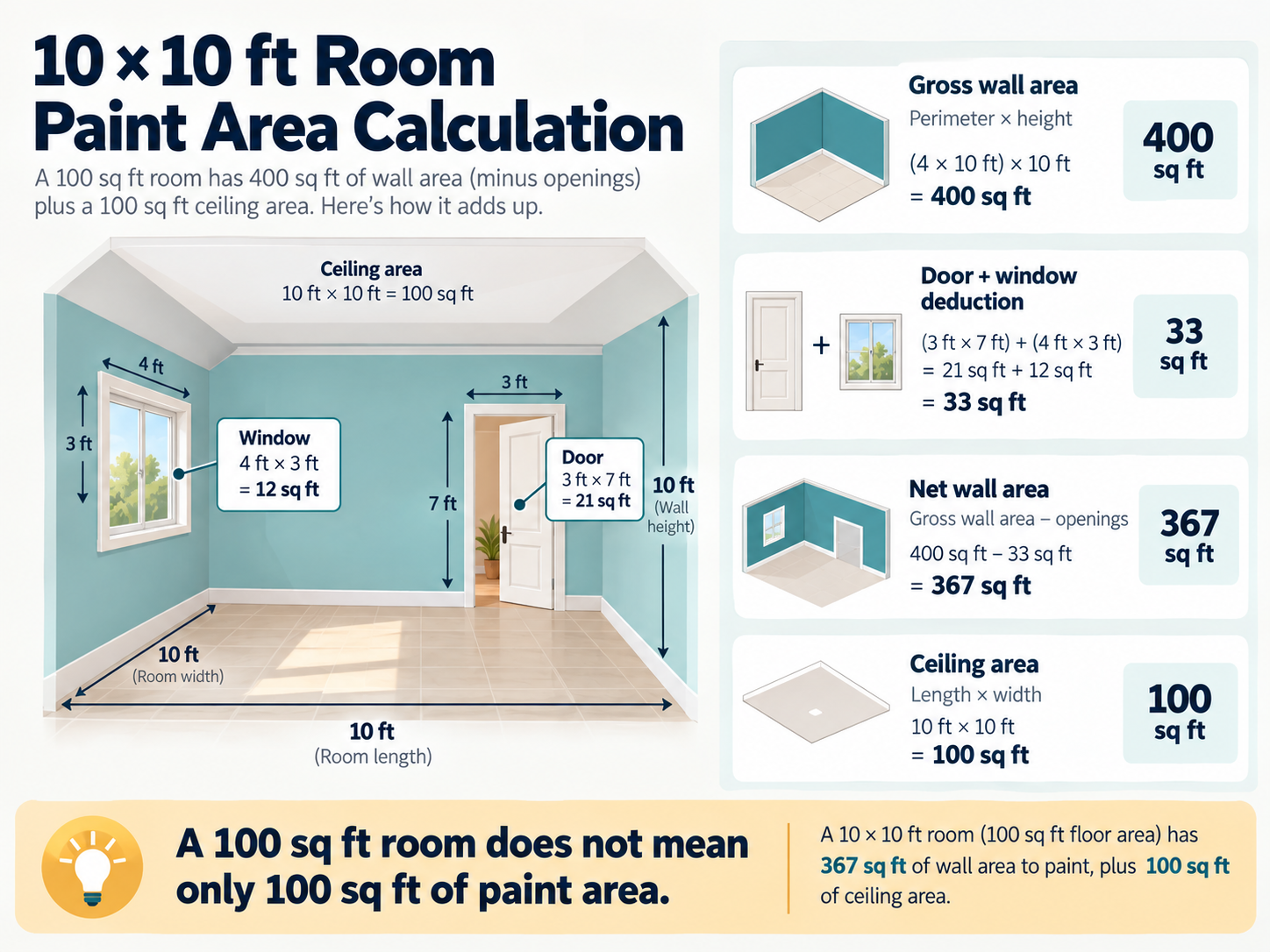
Write 367 sq ft beside the room sketch. Now you have a number the painter and paint dealer can both work with, rather than a room size each might interpret differently. Before putting the tape away, look at the doorway and window again. The shutter and frame may need finishing, and the sides of a deep window opening add narrow surfaces of their own. Deducting the main opening does not make those jobs disappear; it simply keeps them out of this flat-wall calculation. Wood and metal may need different products too.
Turn 367 sq ft into litres of paint
At the paint shop, two tins can sit beside each other, look much the same and offer different coverage. The wall underneath matters as well: a smooth, prepared surface and a rough, thirsty one will not necessarily use the same amount. For a clear worked example, suppose the chosen paint covers 250 sq ft per litre in one coat, and the painter plans two finish coats. Those are the assumptions we will carry through the next few steps.
The calculation is 367 × 2 ÷ 250 = 2.94 L (rounded). Add an illustrative 10% allowance for paint left on tools, small touch-ups and similar losses, and the figure becomes 3.23 L. This is the wall-paint requirement before rounding up to a pack size.
Do not copy the 250 sq ft figure blindly onto a different tin. For example, the Asian Paints Tractor Emulsion product information gives expected coverage of 250–270 sq ft/L for one coat and 130–150 sq ft/L for two coats together on a normal masonry surface after brushing. The second figure already accounts for two coats; multiplying it by two again would overstate your requirement. Check the coverage instructions for the product you choose, especially if your walls are rough, porous or heavily patched.
At the paint shop, decide whether the ceiling is part of the job
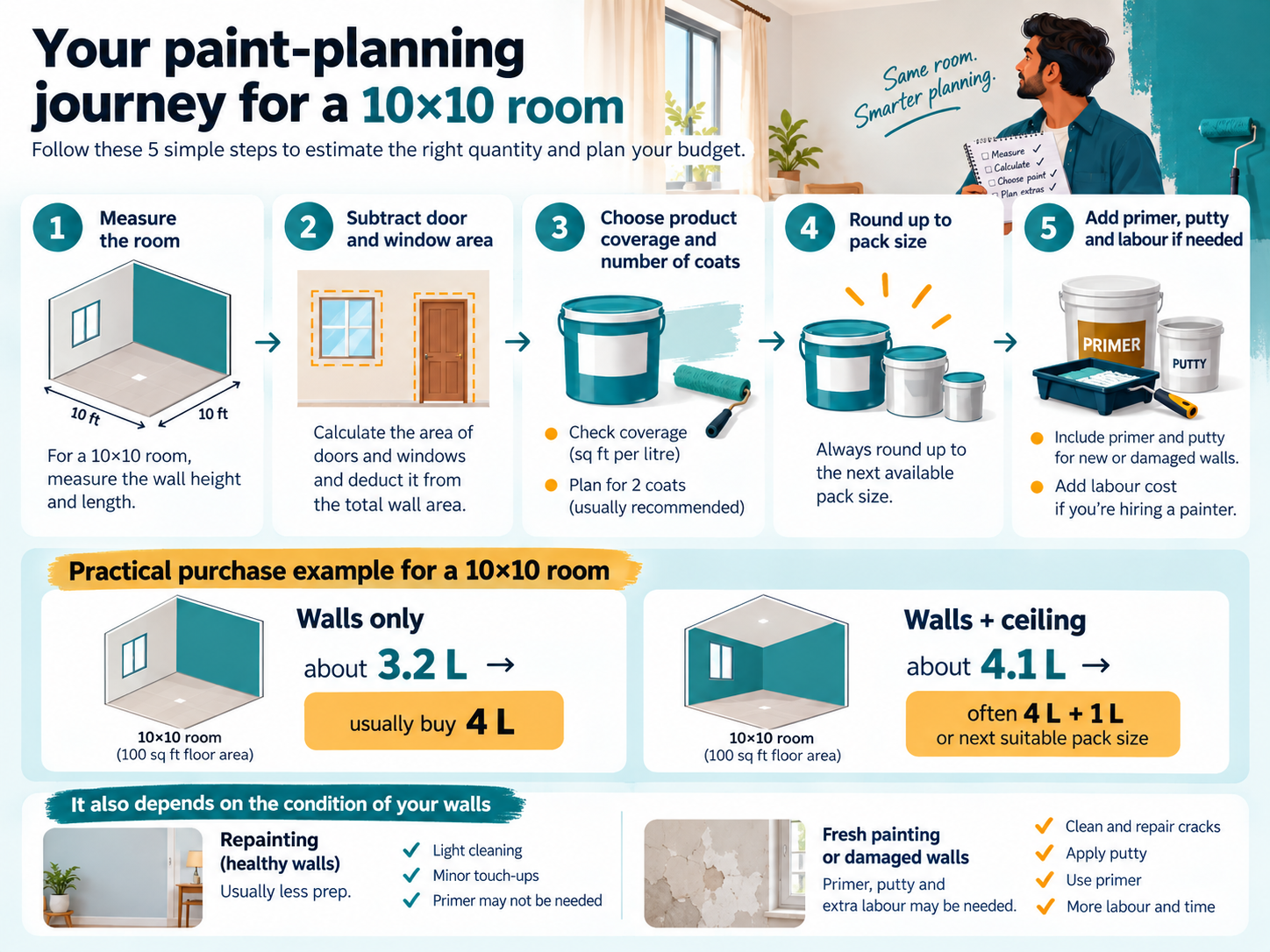
For the walls alone, three 1 L packs would not meet the calculated 3.23 L requirement. One 4 L pack or four 1 L packs would, provided the paint and shade are available in those sizes. A 10 L or 20 L pack is more than this room needs for its walls; it becomes relevant only if you are also painting other spaces in the same product and shade. Check the actual pack prices before deciding—buying the smallest number of tins is not always the cheapest option.
Just as the wall-paint order looks settled, someone says, “We should do the ceiling while the furniture is covered.” Quite reasonable—but it changes the shopping list. This room's ceiling adds 100 sq ft, about 9.3 m². Under the same example assumptions, it needs 100 × 2 ÷ 250 × 1.10 = 0.88 L. If the walls and ceiling use exactly the same paint and shade, the total reaches about 4.11 L. The 4 L pack that was comfortable for the walls is now slightly short. A 4 L pack plus a 1 L pack is one possible combination.
In many rooms the ceiling is white while the walls are another shade. If that is your plan, work out and buy the ceiling paint separately. Do not assume you can use the wall-paint balance on the ceiling, or that primer and putty can be counted as part of the 3.23 L finish-paint figure. Water added for thinning is not additional paint bought in litres; follow the selected product's dilution instructions.
The patch behind the curtain deserves a closer look
Imagine two 10×10 bedrooms on the same landing. In one, the paint is sound and the owner wants a warmer colour. In the other, moving the curtain reveals peeling paint, an uneven old repair and a crack that has returned. From the doorway they are much the same room. To the painter, they are different jobs. The wall area may match exactly; the work needed before the first finish coat does not.
For a sound repaint, ask the painter to show you what needs cleaning, sanding and local filling. That makes “preparation” a visible job instead of a vague charge. Changing colour does not automatically mean covering every wall with putty. Loose or chalky paint needs attention before fresh paint goes over it. A damp patch needs the moisture source found and fixed first; a new colour cannot repair a leak. A recurring or substantial crack needs assessment rather than another quick covering of putty.
Newly plastered walls are a different job. The surface must be ready for coating, and the selected paint system may call for putty, primer and finish paint in a particular sequence. Ask for those materials and the associated labour to be quoted separately. Their quantities depend on their own product coverage and on where they are being applied—not on the 3.23 L finish-paint calculation. The guide to primer, putty and paint sequence explains what to check before work begins.
Finally, compare the painter's quote with the paint bill
By now, the room has become a fairly clear list: measured walls, selected paint, agreed preparation and a decision about the ceiling. You can finally put the shop's bill beside the painter's quote. The original worked example used ₹953 for a 4 L pack, recorded from the Asian Paints Tractor Emulsion listing. Keep that as an example price, not a promise of today's shop price. Ask for a fresh quotation for the exact product, pack and shade you want.
Now suppose your painter quotes ₹4,500 as a fixed labour charge for painting the 367 sq ft of walls. This is an invented quote used to show the calculation, not a verified local labour rate:
| Wall-only example | Amount |
|---|---|
| One 4 L pack of finish paint, using the listed MRP | ₹953 |
| Assumed labour quote for wall painting | ₹4,500 |
| Paint and labour subtotal | ₹5,453 |
That subtotal does not pay for the ceiling, primer, putty, substantial repairs or other items unless the painter has expressly included them. A job covering fresh plaster will have a different cost from a straightforward repaint, even when both rooms measure 10×10 ft. This is why an unqualified “rate per sq ft” can be misleading: ask whether it is being applied to 100 sq ft of floor, 367 sq ft of net walls, 400 sq ft of gross walls or a lump sum for the room.
Before agreeing to the work, read the quotation as though you were explaining it to someone who has never seen the room. Can they tell which surfaces will be painted, with which product and shade, and how many coats? Can they see the scraping, filling, primer and putty, and who protects the furniture and cleans up? Check taxes as well. A few clear lines now are easier than a conversation halfway through the job about why the ceiling or preparation costs extra.
If your room is 10×12 ft or the ceiling is lower
You do not need a new estimating method for every bedroom size. Keep the same opening deductions, coverage, two coats and 10% example allowance, then change the dimensions. A 10×12 ft room with 10 ft high walls has 2 × (10 + 12) × 10 − 33 = 407 sq ft of net walls, requiring about 3.58 L. A 12×12 ft room under those same assumptions has 447 sq ft of net walls and needs about 3.93 L. Their ceilings would be 120 sq ft and 144 sq ft respectively, if you are painting them.
Height can change the order without changing a single piece of furniture. If the original 10×10 ft room has 9 ft walls, its net wall area is 327 sq ft, and the two-coat paint requirement becomes about 2.88 L, including the same allowance. That is why it helps to keep the actual measurements with the estimate. When you return to the shade card, you are choosing a colour with a much clearer idea of the work behind it: what needs repair, what gets painted and what needs to come home from the shop.