5000 Litre RCC Underground Water Tank Cost: A Complete Worked Budget
Work through a ₹98,000 illustrative budget for a 5,000 litre RCC underground water tank, with clear quantities, exclusions and smaller-capacity comparisons.
construction
In this guide8 sections
Suppose your water supply arrives at a fixed time each morning. Someone watches the tap while someone else lines up buckets. When the supply runs late, the rest of the morning slips with it. A 5,000 litre underground tank sounds like a practical way to keep water available—but what would it cost to build?
Before pricing the job, the contractor needs to know where the tank will go: in the courtyard or beneath the driveway? That question brings the structure and site into the picture. Building the tank means paying for concrete and steel as well as excavation and waterproofing. Capacity alone does not tell you how much concrete, steel or excavation the tank needs.
The 5,000 litre RCC tank in this worked example costs ₹98,000, or ₹1,07,800 with a separate 10% reserve. RCC means reinforced concrete. The budget includes excavation, concrete, steel, formwork, waterproofing, small pipe connections and labour. Pumps, long pipe runs and the finished surface above are separate. These quantities and prices are illustrative; your budget needs to reflect approved drawings, site conditions and written quotes.
To see where the money goes, start with the water space, then follow the drawing-based concrete and steel quantities into the cost sheet. With those costs clear, it becomes easier to compare smaller tanks and spot gaps in a quotation.
Separate water space from the structure around it
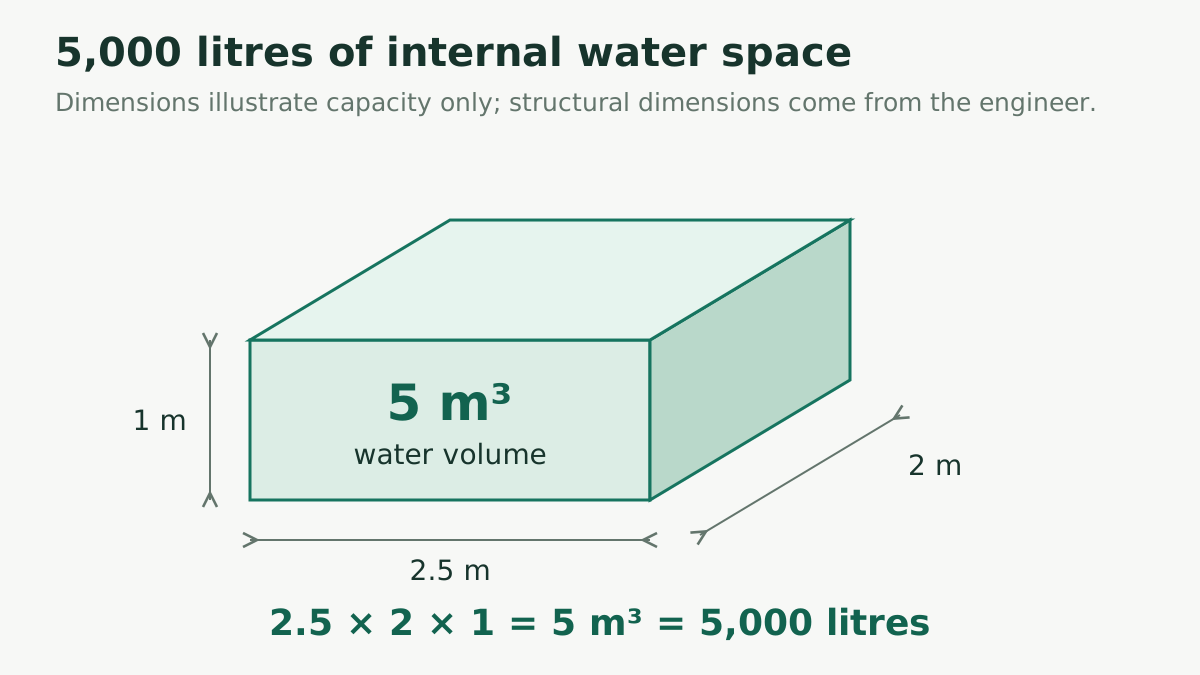
When you say “5,000 litres”, you are describing how much water the tank holds. The concrete base, walls and cover take up space of their own. Since 1 m³ = 1,000 litres, a 5,000 litre tank needs 5 m³ of water space. Measure between the finished internal surfaces up to the specified water level. The empty space above that level, called freeboard, does not count towards water capacity.
| Capacity | Internal dimensions illustrating water volume only |
|---|---|
| 1,000 litres | 1 × 1 × 1 m = 1 m³ |
| 3,000 litres | 2 × 1.5 × 1 m = 3 m³ |
| 5,000 litres | 2.5 × 2 × 1 m = 5 m³ |
These dimensions simply show how water volume is calculated. Your engineer specifies the actual dimensions, freeboard, base, walls, cover and reinforcement. 5,000 litres of water is not 5,000 litres of concrete.
Confirm the location before pricing the excavation
The location affects both the design and the work needed to dig the pit. Tell the engineer whether the tank will sit in a courtyard or beneath an area used by vehicles. The design must account for soil pressure, groundwater, nearby foundations and loads above the cover. Even an open area needs to be assessed for safe excavation.
Before asking for a price, agree on where the excavated soil will be stored or taken away and how workers and materials will reach the pit. Ask whether temporary support or dewatering—removing water from the excavation—needs a separate allowance. A capacity figure alone cannot answer these site questions.
Work out concrete and cement from the approved drawings
Once the site requirements are clear, turn to the quantities measured from the drawings. In this hypothetical example, the reinforced base, walls and cover contain 2.8 m³ of concrete. A separate base layer is excluded from that volume and priced separately below. The cement requirement follows the concrete volume and approved mix. When planning the order, also ask about losses during placing and any minimum delivery requirements.
For example, if the approved mix schedule specifies 320 kg of cement per m³, the calculation is 2.8 × 320 = 896 kg. At 50 kg per bag, that works out to 17.92 bags → 18 whole bags, before placing losses. The 320 kg figure is an illustrative input from a supplied specification, not a recommended tank mix. Take the sand, aggregate and other ingredient quantities from the approved mix as well.
This calculation helps you understand the material requirement. If your concrete supply rate already includes cement, sand, aggregate and mixing, adding a separate cement cost would count it twice. Use the concrete calculator to check quantities from supplied dimensions; it does not design the mix.
Keep the steel schedule and purchase plan together
Next, check the reinforcement schedule—the list of bars required by the drawings. Assume it totals 350 kg of steel. The schedule gives bar diameters, cut lengths, bends and laps (the overlaps between bars). The cutting plan then determines how many whole bars to buy.
If the purchase quantity is also 350 kg, an assumed rate of ₹65/kg gives 350 × ₹65 = ₹22,750. Make sure the quote also states how binding wire and the labour for cutting, bending and tying are covered.
The rebar calculator can help you check the weight of the listed bars. For more help reading a schedule, see the roof steel guide, keeping in mind that its roof quantities do not apply to a tank.
Add the work required for a finished tank
Concrete and steel are substantial costs, but they are only part of the finished job. The table below brings them together with excavation, waterproofing, connections and the remaining work.
All rates are assumed. The concrete supply line includes materials and mixing. Formwork—the temporary moulds that hold concrete in shape—includes erection and removal. Concrete placing and reinforcement tying appear in a separate labour line.
| Work | Example basis | Amount |
|---|---|---|
| Excavation | 11 m³ × ₹550 | ₹6,050 |
| Reinforced-concrete material supply | 2.8 m³ × ₹8,000 | ₹22,400 |
| Steel purchase | 350 kg × ₹65 | ₹22,750 |
| Formwork | 24 m² × ₹450 | ₹10,800 |
| Separate base-layer work | Allowance | ₹3,000 |
| Plaster and waterproofing | Materials and application | ₹12,000 |
| Access cover and small pipe connections | Supply and fitting | ₹4,500 |
| Reinforcement tying and concrete placing | Labour | ₹8,500 |
| Agreed checks and cleaning | Allowance | ₹2,000 |
| Delivery, soil handling and backfill | Allowance | ₹6,000 |
| Subtotal | — | ₹98,000 |
Adding a separate 10% reserve of ₹9,800 brings the budget to ₹1,07,800. This example excludes pumps, filters, long pipework, dewatering, special supports, a revised design for vehicle loads, restoring the surface above the tank and applicable taxes. If your site needs any of these, obtain a separate price.
You can check supplied excavation quantities in the excavation and backfilling calculator. The tool checks quantities; site requirements such as support and dewatering still need to be established separately.
Agree on waterproofing and testing before work starts
The waterproofing and checking lines deserve attention even though they are smaller than the concrete and steel amounts. Put the method in writing, including how the wall-to-base joints and pipe openings will be treated and which internal lining is specified. Work out coating quantities from the actual area to be treated and the product instructions.
For drinking-water storage, confirm that the selected internal product is suitable for contact with drinking water. Dr. Fixit's tank-waterproofing guidance discusses tank-specific treatments and product suitability. A coating intended for a roof is not automatically suitable as a tank lining.
Agree on curing, cleaning and water testing as part of the work. Keep the house's longer water-distribution lines in a separate plumbing estimate, so it is clear where the tank work ends and the house plumbing begins.
Compare capacities using separate designs
Once the full 5,000 litre budget is visible, it is natural to ask how much a smaller tank would save. The examples below use separate hypothetical drawings; the final row is the tank priced above.
| Capacity | Hypothetical concrete | Hypothetical steel | Assumed construction subtotal | Subtotal per litre |
|---|---|---|---|---|
| 1,000 litres | 0.9 m³ | 110 kg | ₹45,000 | ₹45 |
| 3,000 litres | 1.8 m³ | 220 kg | ₹75,000 | ₹25 |
| 5,000 litres | 2.8 m³ | 350 kg | ₹98,000 | ₹19.60 |
Delivery, access covers, connections and minimum labour still need to be paid for when the tank is smaller. That is why five times the capacity does not necessarily mean five times the cost. Treat the per-litre figures as a comparison of these examples, rather than a rate you can apply to another size. Obtain a separate drawing and complete quote for the capacity you need.
When comparing contractors, give each one the same water-storage capacity, drawings, steel schedule, waterproofing requirements and testing scope. Check soil disposal and backfill too. Before comparing totals, make sure both quotes cover the same work: a price for the structure alone will include less than a price for a ready-to-use tank. Compare possible savings through the itemised supply and labour lines. Any proposed reduction in the structure requires revised approval from the engineer.
Questions that often come up
What does a 5,000 litre RCC tank cost?
In this worked example, the subtotal is ₹98,000, or ₹1,07,800 with a separate 10% reserve. Ask for a written quote based on your site conditions and approved drawings.
What about 1,000 and 3,000 litre tanks?
The separate illustrative budgets are ₹45,000 for 1,000 litres and ₹75,000 for 3,000 litres. Smaller tanks still have costs such as covers, delivery and minimum labour, so the price does not fall in direct proportion to capacity.
How much steel does the tank need?
This 5,000 litre example uses 350 kg. The quantity for your tank must come from the engineer's drawings and the schedule showing how the bars are cut and bent.
How are cement bags calculated?
Multiply the concrete volume by the cement required per m³ in the approved mix. At the example input of 320 kg/m³, 2.8 m³ requires 896 kg, or 17.92 bags of 50 kg each. That rounds up to 18 whole bags before placing losses.
Does the amount include the pump?
No. The pump and long pipe runs are separate in this example. Before accepting a quotation, also confirm who is responsible for the access cover, small pipe connections, leak testing and backfill.